📖 For students
Why we travel
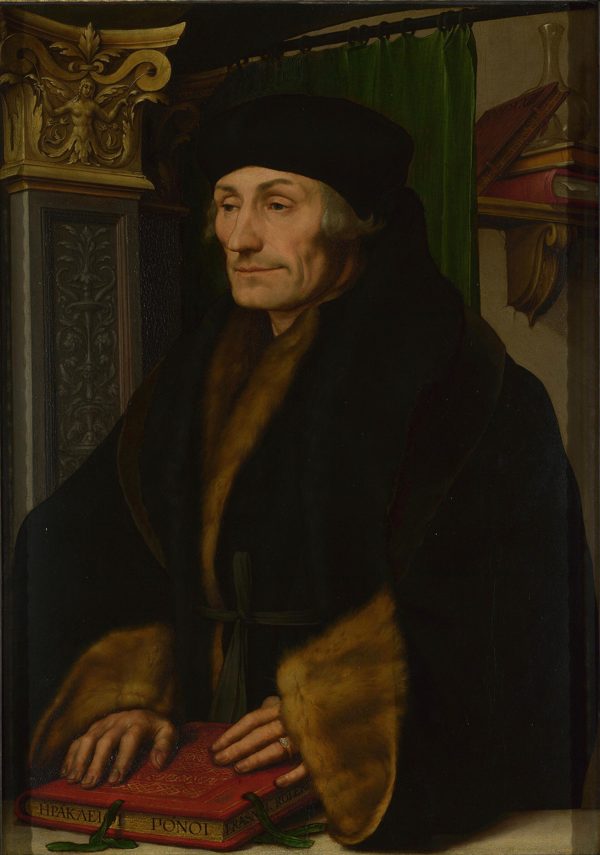
Erasmus (c. 1466–1536) was a Dutch humanist from Rotterdam. He studied in Paris, taught at Cambridge, earned a doctorate in Turin and worked in Basel. The European Erasmus programme, launched in 1987, bears his name in tribute to this scholar who travelled across Europe to study and teach.
A name with a story
The Erasmus programme is named after Erasmus, a humanist from Rotterdam, in the Netherlands. He lived about 500 years ago. He studied and worked in Paris, in Cambridge, in Italy and in Basel. For him, knowledge did not belong to one country. It travelled from city to city, with books and with the people who carried them.
Travelling was not a holiday
In 1580, the writer Michel de Montaigne left his home and travelled on horseback to Switzerland, Germany and Italy. He was ill: he had kidney stones, and every step of his horse was painful. He went anyway, because seeing the world makes you richer.
Your journey today
An Erasmus trip starts with paperwork: an official form, boxes to tick, dates to remember. Do it carefully, but it is not the point of the journey. The point is to meet other people, to show them what you can do, and to learn what they can do.
How you might feel
You will probably feel nervous at first: a new language, new habits, the fear of not being good enough. That is normal. Then, very often, you will feel proud.
What has not changed
You leave with your knowledge, and you come back with other people’s knowledge too. And sometimes, you come back as someone new.
🔤 Words to help
Words to help
- a humanist: a thinker who loves books, languages and learning
- knowledge: what you know and what you can do
- on horseback: riding a horse
- kidney stones: small hard stones inside the body; they hurt a lot
- anyway: even so, even if it is difficult
- paperwork: forms and documents to fill in
- nervous: a little afraid before something new
- proud: happy about what you did
✏️ Check you understand
Three questions
- Where was Erasmus from, and where did he live?
- Why was Montaigne’s journey difficult?
- According to the text, what is the real point of an Erasmus trip?
Check your answers
- He was from Rotterdam, in the Netherlands. He lived in Paris, in Cambridge, in Italy and in Basel.
- He was ill (he had kidney stones), and travelling on horseback was painful.
- To meet other people, to show them what you can do, and to learn what they can do.
💬 Your turn
Your turn: speak or write
Choose two or three starters. Speak for one minute, or write three or four sentences.
- Before a trip abroad, I would feel… because…
- Travelling can change you because…
- In Brighton, I could share… and I could learn…
- Meeting people from other countries helps you…
- The most difficult thing for me would be… but…
- When I come back, I hope I will…
Ready? The Brighton sequence starts here.
Images
Palace Pier, Brighton, 21 February 2015 · Photo Dave Price, Wikimedia Commons (Geograph) · CC BY-SA 2.0.
Erasmus, Hans Holbein the Younger, 1523, National Gallery, London · Wikimedia Commons · Public domain.

